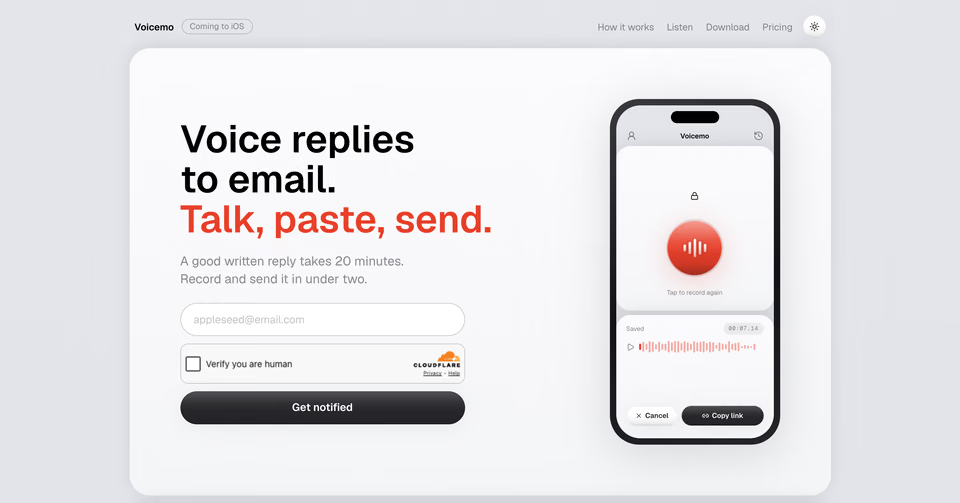
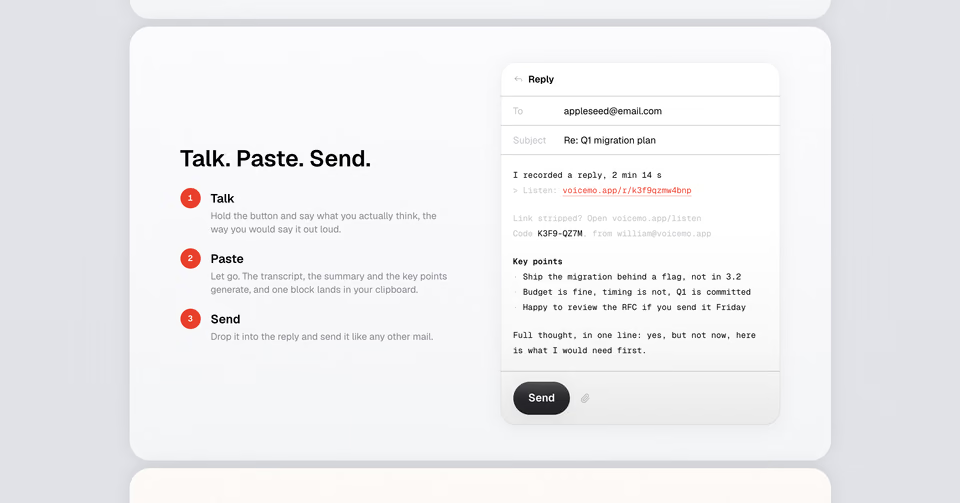
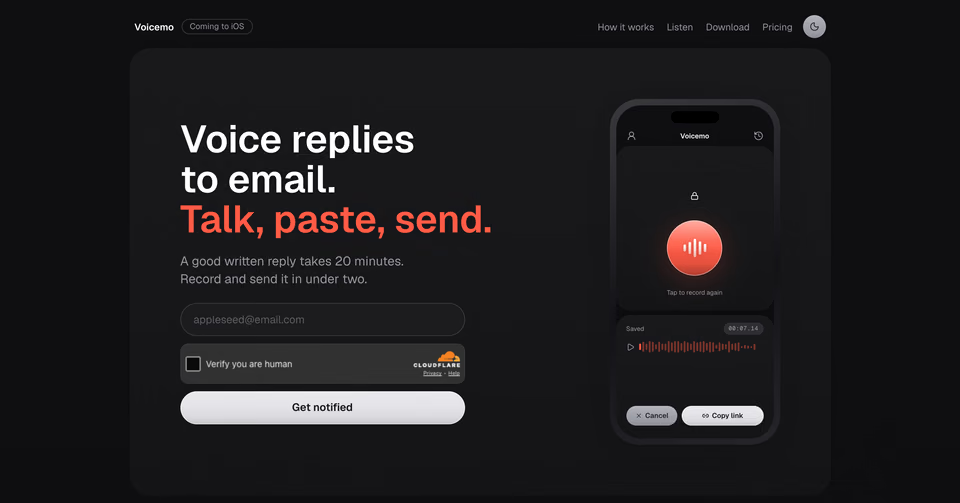
Talk, paste, send. Record a reply on your phone, paste one block with a listen link into the email, and the reader listens in the browser: no app, no account.
TLDR;
Voicemo is a voice reply for email. Hold the button, say what you actually think, and paste one block into the reply: a listen link, the duration, and on Pro the transcript.
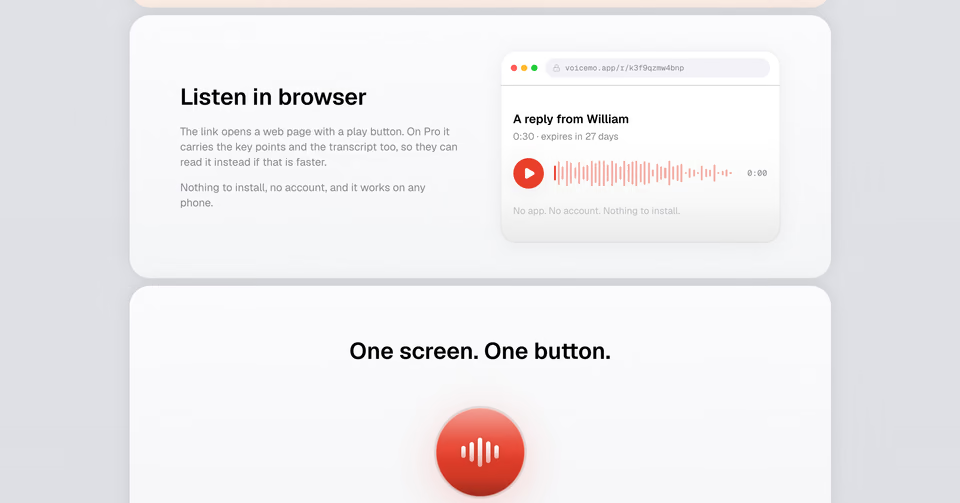
The recipient opens a minimal web page: a play button, a waveform and the text. No app, no account.
Every recording has an expiry date and is hard-deleted when it runs out. The iOS app is coming to the App Store, the site and the share pages are live on voicemo.app.
The issue
The most comprehensive reply can't be written, it needs expression.
Email that asks for an opinion takes real time to answer well, and the usual workarounds all fail:
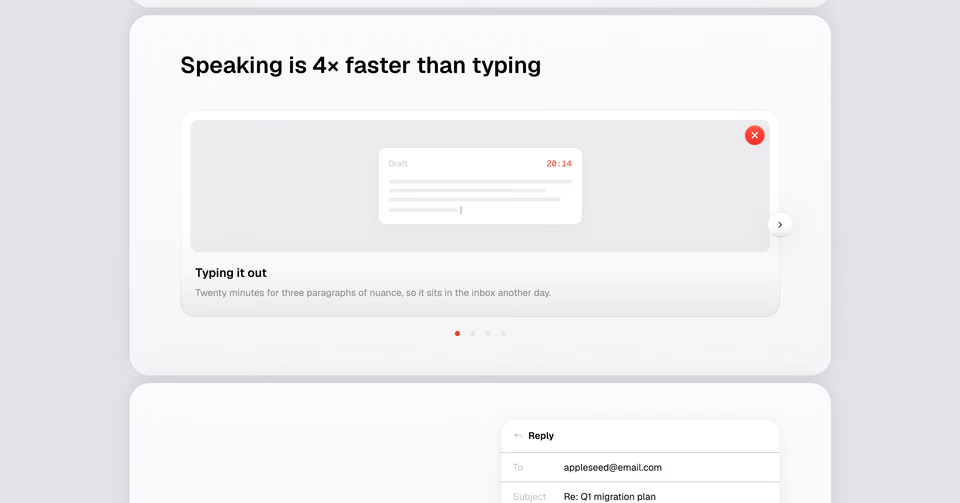
- Typing it out: twenty minutes for three paragraphs of nuance, so the mail sits in the inbox another day
- Dictation: fights you the whole way, needs correcting line by line, and ends up slower than typing
- A voice note: convenient for the sender, rude to the reader. No context, no way to skim it, and no way to know it was heard
Voicemo is built against the third one. Speaking is about 4× faster than typing for a nuanced opinion while reading stays just as fast, so the sender saves the time and the reader loses none, as long as the reply stays easy to open and to skim.
Process
Built in two weeks in September 2026: the app, the backend and the site together.
- Hold to record: the recorder is a sheet mounted at the root, not a route, so the gesture that starts a recording is never broken by navigation. Release pauses, holding again carries on, and "Save take" joins the parts into one file
- Offline first: a paused take survives the app being killed, the app opens with no network, and the audio uploads once, straight from the phone to storage through a signed URL
- A title for free: on-device speech recognition names every recording, so the history list stays readable on both tiers
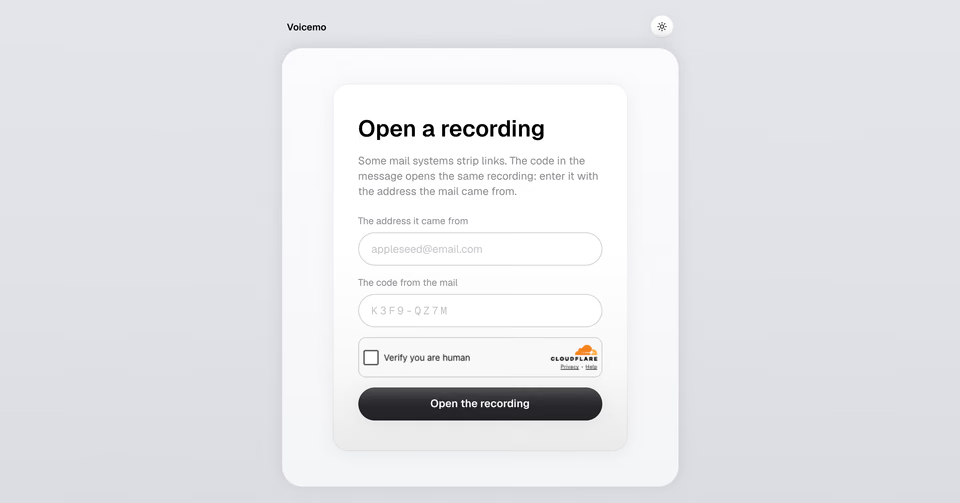
- The share page: one server-rendered page per recording with the player, the waveform and, on Pro, the transcript. For mail systems that strip links, a typed code at /listen finds the same recording, scoped to the sender's address and rate limited behind Turnstile
- Expiry as a feature: an hourly job hard-deletes expired audio, transcripts and rows. It is the GDPR posture and a selling point at once
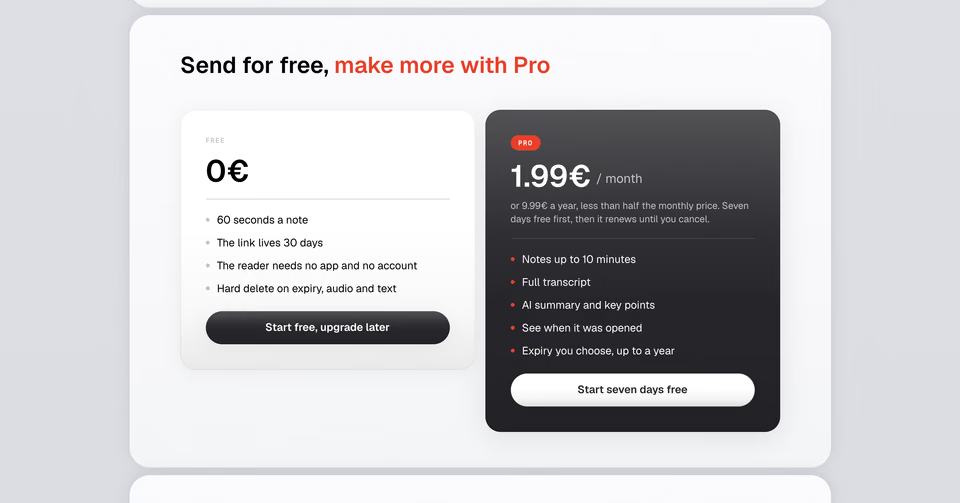
- Subscriptions: free sends the voice, Pro makes it worth the reader's time. App Store billing through RevenueCat, mirrored into the backend so the phone never decides what an account may do
- A visual language: glass for what you touch, paper for what you read, gradient and grain for the room. Liquid Glass controls, moulded cards, and a film grain that turns a gradient into a surface
The stack
- Expo + React Native: the iOS app, with expo-router, native sheets and Liquid Glass
- Convex: database, actions, rate limiting, a work pool and the expiry cron
- Clerk: passwordless email codes and Sign in with Apple
- Cloudflare R2: audio storage, uploaded directly from the phone
- RevenueCat: App Store subscriptions and the paywall
- Next.js 16: landing page, share pages and the code lookup, on Vercel
- Cloudflare Turnstile: bot protection on the waitlist and the code lookup
- Geist + Geist Mono: one type family across the app and the site
Communication and Marketing
The pitch lives in a twelve-slide deck presented on stage: the positioning, the three failures and the tiers. The landing page reuses its approved copy word for word, and every section carries an illustration instead of a paragraph asking to be believed: a real mail window, a real browser page, the real record button.
It is written for people whose inbox asks for opinions rather than confirmations: founders, managers, consultants, engineers doing review.
Until the App Store release, Get notified collects a waitlist.
Deliverables
- iOS app: recording, history, sharing, expiry, profile and subscriptions
- Backend: auth, direct-to-storage uploads, sharing, expiry and billing
- Website: landing page, share pages, code lookup and legal pages
- Design tokens: the site's palette is generated from the app's theme, so the two never drift apart
 Voicemo